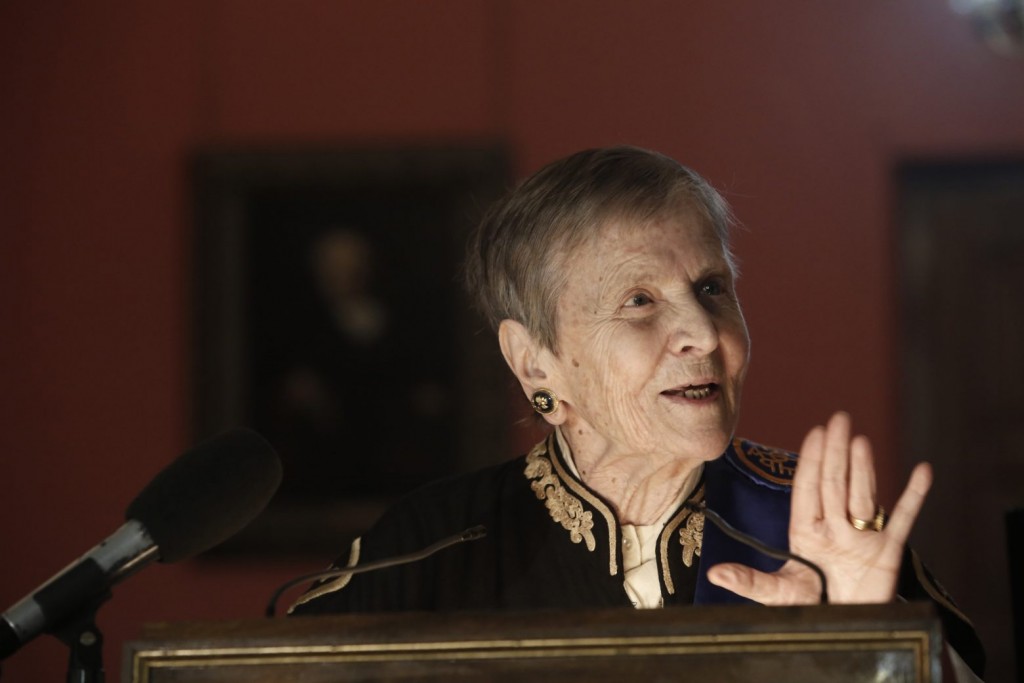




Hélène Glykatzi-Ahrweiler, the renowned historian, passed away at the age of 99. She is survived by her daughter Marie-Hélène. The extraordinary UNICEF Goodwill Ambassador for Greece lived a full life, marked by many accolades and important moments.
Glykatzi is considered one of the most distinguished academic figures in Byzantine studies. Throughout her career, she delivered countless lectures and speeches both in Greece and abroad. She was rector of Sorbonne University from 1976, chancellor of Paris universities, director of the Center for Byzantine History and Culture, and president of the European Cultural Center in Delphi. She was honored with numerous international accolades for her academic achievements. Her books include The Political Ideology of the Byzantine Empire (1975), Smyrna Between Two Turkish Occupations (1975), Diaspora in Byzantium (1995), and The Making of Europe (2000).
Remembering an extraordinary life
Born in Athens in 1926, Glykatzi moved to France in 1950. She became the first female president of the History Department at the University of Sorbonne in 1967, and in 1976, she was appointed the first female rector in the 700-year history of the University of Sorbonne. She also served as rector of the University of Europe.
She graduated from the Faculty of Philosophy at the University of Athens. After completing her studies, she worked as a researcher at the Asia Minor Studies Center and moved to Paris in 1953 to continue her academic work. Two years after her arrival, she was appointed to the National Center for Scientific Research in France (CNRS). In 1964, she became the director of the center and, in 1967, a professor at Sorbonne, where she was awarded the title of Docteur des Lettres. She also served as the Director of the Center for Byzantine History and Culture at Paris 1 University, and was elected Vice-Rector of Sorbonne University (1970-1973). In 1976, she became the rector of Sorbonne. It was there that she met her husband, Jacques Ahrweiler, a French Army officer, with whom she had a daughter.
Glykatzi-Ahrweiler held various prestigious roles, including President of the European University, the Ethics Committee of the National Center for Scientific Research (France), the European Cultural Center of Delphi (Greece), and Honorary President of the International Committee of Byzantine Studies. She also served as President of Paris University, Rector of the Paris Universities, and President of the Georges Pompidou Center in Beaubourg.
Her scholarly work mainly focused on Byzantine studies. Notable works include Studies on the Administration of the Byzantine Empire in the 9th and 10th Centuries (1960), Byzantium and the Sea (1966), Studies on the Administrative and Social Structure of Byzantium (1971), Byzantium, the Country and Its Lands (1976), and The Political Ideology of the Byzantine Empire (1976). She was also known for her strong liberal values and commitment to free expression. As she once mentioned in an interview, “I never allowed a policeman to enter Sorbonne while I wasn’t there in person.”
Her resistance activities during the Occupation, student life in post-war Athens, and friendships formed during the period of “rebuilding the world” culminated in an exciting rendezvous at the Eiffel Tower for graduate studies in 1950s Paris. At the Sorbonne, she was surrounded by the magical atmosphere of Saint-Germain-des-Prés, the artistic and intellectual circles—Picasso, Simone de Beauvoir, Louis Aragon, Elsa Triolet, Claude Roy, Nathalie Sarraute, Françoise Sagan, Luis Buñuel, José Bergamín. She participated in ideological debates, witnessing the era’s transformations through publications such as Express, with writers like Manté Frans, François Mauriac, and François Giroud.
Her significant role in European society includes meetings with Konstantinos Karamanlis, frequent communication with him, and a memorable gathering at Claude Pompidou’s house, also attended by Simone Weil, Mireille Mathieu, Guy Béart, and many others. She also served as president of the National Center for the Arts “Georges Pompidou.”
She built trusted relationships with François Mitterrand, Valéry Giscard d’Estaing, and Jacques Chirac. As rector of Sorbonne, she met with world leaders such as Indira Gandhi, Zhao Ziyang, and others. During her tenure, she established 40 Greek academic chairs in Paris. Her political moments from travels with Mitterrand, her time in Washington, and dinner at the White House are also part of her legacy.