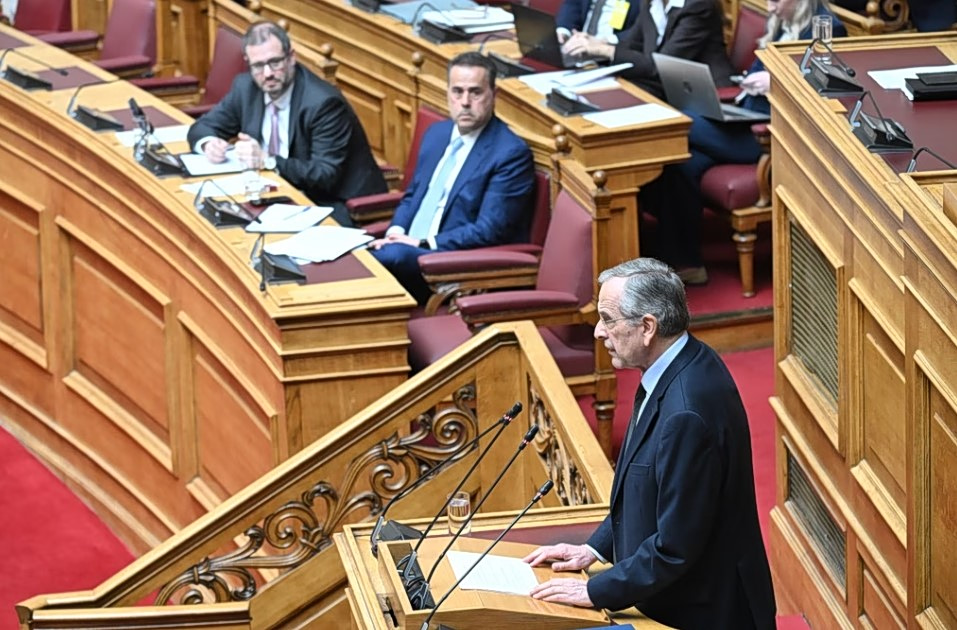



Α parliamentary debate over Greece’s offshore energy agreement with Chevron and HELLENiQ Energy turned tense on Thursday, as former Prime Minister Antonis Samaras openly challenged the government’s handling of the deal once again, while Energy Minister Stavros Papastavrou stepped in to defend it.
Lawmakers are currently discussing in Parliament a bill that would grant the consortium rights to explore and potentially exploit hydrocarbons in offshore areas south of Crete and the Peloponnese.
Speaking from the parliamentary podium, Samaras addressed previous remarks made by Prime Minister Kyriakos Mitsotakis about what he described as “professional worriers.”
Samaras said he would avoid revisiting several issues he had previously raised — including alleged profiteering, and surveillance monitoring that he said concerned him personally, and what he described as “paid trolls that poison democracy.”
“I will not raise those concerns today,” he said, adding sarcastically that doing so might once again prompt accusations about “professional worriers” or “armchair patriots.”
Samaras questioned what the prime minister meant by the phrase, noting that media coverage had suggested it referred to him and fellow former prime minister, Kostas Karamanlis.
“I do not want to believe that Kyriakos Mitsotakis is accusing two former prime ministers and leaders of New Democracy of making a career out of voicing national concerns,” Samaras said in a pointed remark, adding “there are no professional worriers; only amateurs in complacency.”
Concerns over a key provision
Samaras reiterated his opposition to parts of the bill under discussion, focusing in particular on Article 30 of the agreement.
According to the former prime minister, the way the provision is written could leave room for the application of what Greece considers the illegal Turkey-Libya maritime memorandum.
He argued that the wording could allow for a possible reduction in the area covered by the agreement, warning that it could effectively signal “a potential reduction of sovereignty.”
Despite his criticism of the legislation, Samaras praised what he described as the government’s quick response regarding Cyprus amid heightened tensions in the Middle East. “The geopolitical moment is an ideal opportunity that should not be lost,” he said, adding that Cyprus is European territory and that the permanent presence of European and Greek forces there is necessary.
Energy minister pushes back
At the conclusion of Samaras’ remarks, Papastavrou requested the floor to respond.
The minister rejected the suggestion that the agreement could affect Greece’s sovereign rights, saying such rights cannot be transferred through contracts like the one under discussion.
“The contracts with Chevron do not create obligations between states and, under international law, they do not transfer sovereign rights,” Papastavrou said.
Addressing Samaras directly, Papastavrou referred to their cooperation during a previous government.
“In August 2012 you asked me to take on a critical negotiation,” the minister said. “During very difficult moments for our country, we worked together and achieved what once seemed impossible.”
Papastavrou added that the former prime minister appeared to be drawing conclusions based on incomplete information. “In this specific case, you do not have the full picture and are being led to the wrong conclusions,” he said to the former PM Samaras.
Papastavrou also defended the broader policy behind the agreement, arguing that it would significantly expand Greece’s offshore exploration efforts.
According to the minister, the contracts double the areas available for exploration and increase the likelihood of discovering hydrocarbon deposits. “These agreements double the exploration areas and significantly increase the chances of finding deposits,” Papastavrou said.
Source: tovima.com