


Six months ago, Prime Minister Kyriakos Mitsotakis stood before the country’s most powerful business lobby and promised to ease the energy costs crippling Greek industry. On Monday, his government unveiled a €300 million package intended to deliver on that pledge. Critics wasted little time calling it too modest for the moment.
The announcement came at a perilous time. With conflict in the Middle East showing no sign of abating and energy prices skyrocketing across Europe, Greek manufacturers have grown increasingly vocal about their struggle to compete with rivals in countries where electricity costs far less.
“Six months of difficult negotiations with the European Commission,” is how Environment and Energy Minister Stavros Papastavrou characterized the effort required to get the package approved; a framing that did little to quiet those who questioned whether what emerged was worth the wait.
A Package Built on Two Pillars
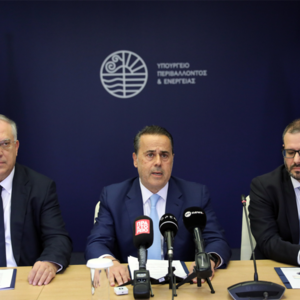
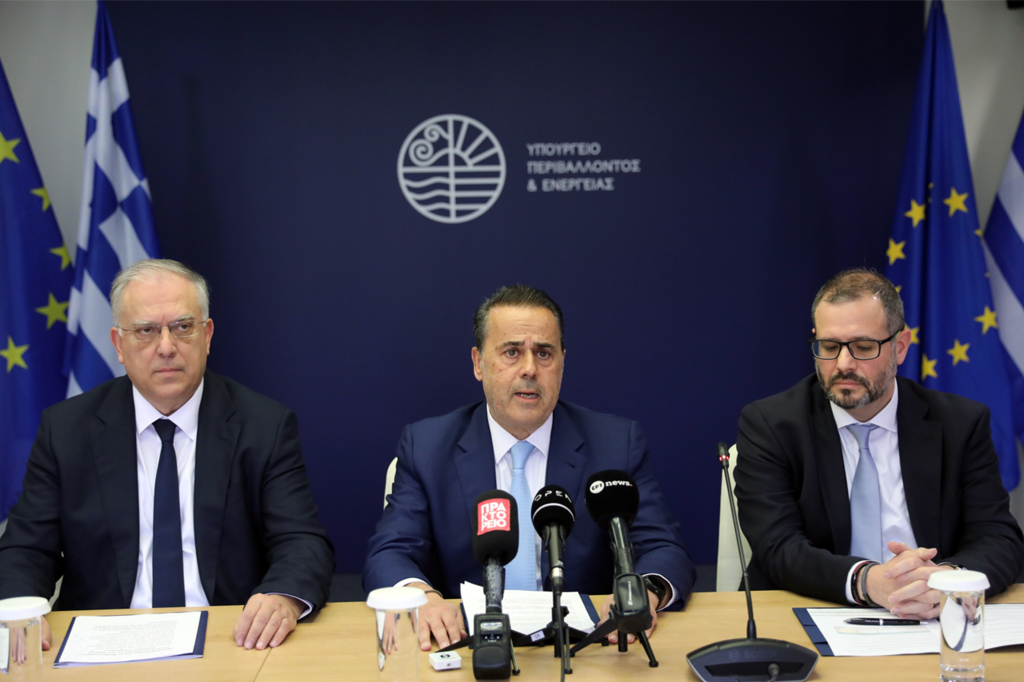
The plan, presented jointly by Mr. Papastavrou, Development Minister Takis Theodorikakos and Deputy Energy Minister Nikos Tsafos, is organized around two broad objectives: cutting electricity bills immediately for the country’s most energy-hungry industries, and financing longer-term upgrades to industrial infrastructure.
The first pillar commits €100 million a year for the next five years to directly reduce electricity costs for large industrial consumers. The second sets aside €200 million — drawn from the European Union’s Modernization Fund, which is financed by revenues from carbon emissions trading — as grants for companies willing to overhaul aging equipment and buildings.
Together, the measures are intended to benefit roughly 23,000 businesses connected to Greece’s medium- and high-voltage electricity grid, alongside a smaller group of 40 to 50 particularly energy-intensive industrial companies.
Immediate Relief, With Conditions
The most concrete near-term change affects those large industrial consumers, for whom Greece has negotiated a new coefficient governing compensation for carbon dioxide emission costs. The rate will rise from 0.58 to 0.82 tons per megawatt-hour, effective from 2026 through 2030 — a technical adjustment that translates, in practice, to meaningfully lower electricity bills. The government estimates the measure will cost around €75 million a year.
Starting July 1, the roughly 23,000 medium- and high-voltage industrial customers will also see a 50% reduction in charges for Universal Service Obligations — fees that help subsidize electricity supply to remote and underserved parts of the country — at a cost to the state of €26 million.
Betting on Modernization
The more ambitious, if slower-moving, part of the package is the €200 million upgrade program, which Mr. Theodorikakos said would open for applications in June 2026.
To qualify, companies must demonstrate that their investment will achieve at least a 10% reduction in energy consumption. The program targets sectors that form the backbone of Greek heavy industry — steel, aluminum, copper, cement, chemicals and pharmaceuticals among them — and covers a wide range of investments, from electrifying industrial vehicles and thermal processes to retrofitting factory buildings and installing battery storage systems designed to accommodate more renewable energy.
Financing can flow through two channels: the European Union’s General Block Exemption Regulation, the standard mechanism for permitting state aid, or through a newer instrument called CISAF, created specifically to bolster industrial competitiveness.