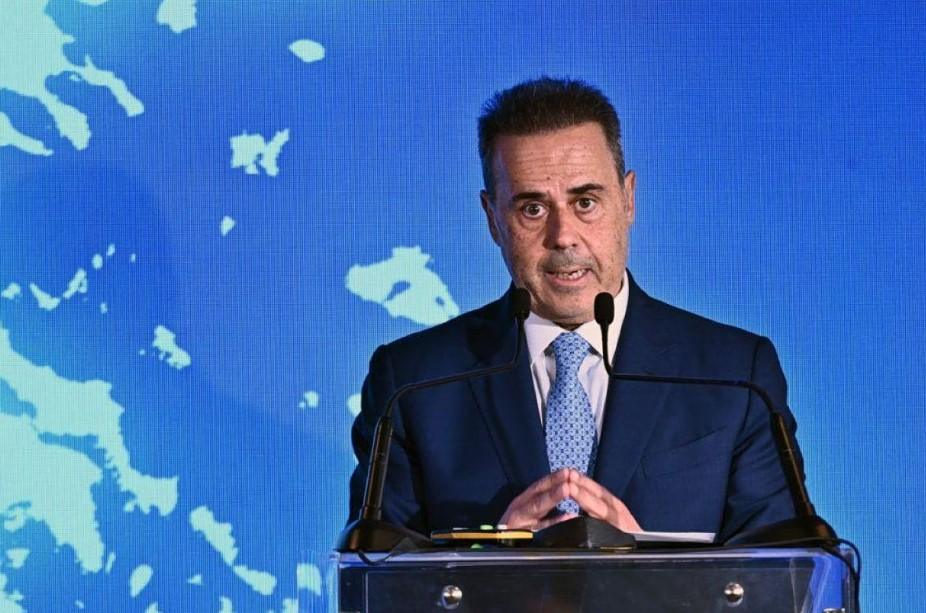


Greece will no longer bankroll the aggressor and must accelerate efforts to phase out Russian fossil fuels, Energy and Environment Minister Stavros Papastavrou said in an interview with the Financial Times, as Athens positions itself at the center of Europe’s post-Russian energy strategy.
“We are not going to keep funding the aggressor,” Papastavrou said. “More needs to be done to gradually eliminate Russian fossil fuels. This decoupling will not happen on its own.”
The Financial Times, in an extensive report on Greece’s role in bolstering Europe’s energy security after the sharp reduction in Russian gas imports, said Athens is seeking to establish itself as southern Europe’s main gateway for liquefied natural gas (LNG), particularly from the United States.
Before Russia’s full-scale invasion of Ukraine in 2022, Moscow supplied around 40% of the European Union’s natural gas. By 2024, that share had fallen to roughly 11%, with much of the shortfall covered by U.S. LNG, which now accounts for nearly 60% of the bloc’s LNG imports, the newspaper noted.
Since taking office in 2025, Papastavrou has pushed for closer energy ties with Washington, framing energy cooperation as a bridge in transatlantic relations at a time of heightened tensions between the United States and the EU.
“What began as emergency LNG supplies from the U.S. after Russia’s invasion of Ukraine has evolved into a longer-term restructuring of the EU’s energy sources,” he told the FT. “American energy has become a structural pillar of Europe’s security architecture.”
The European Union has also sharply reduced imports of Russian oil. Greek-owned tankers have continued to transport Russian crude to other destinations, particularly when spot prices at Russian ports were low enough to comply with the price cap imposed by Kyiv’s allies.
Greece’s ambitions are visible at Revithoussa, the small island west of Athens that hosts the country’s main LNG terminal. Earlier this month, a U.S. cargo was being unloaded at the recently expanded facility. From there, regasified LNG is shipped northward through the so-called “vertical corridor,” a south-to-north supply route developed by Greece, Bulgaria, Romania, Moldova and Ukraine after Russia halted gas exports to Bulgaria in 2022 when Sofia refused to pay in roubles.
Source: tovima.com






![Airbnb: «Φουλ» οι κρατήσεις για το Πάσχα – Οι hot προορισμοί [πίνακας]](https://www.ot.gr/wp-content/uploads/2025/12/ot_airbnb33-1024x600-1.jpg)