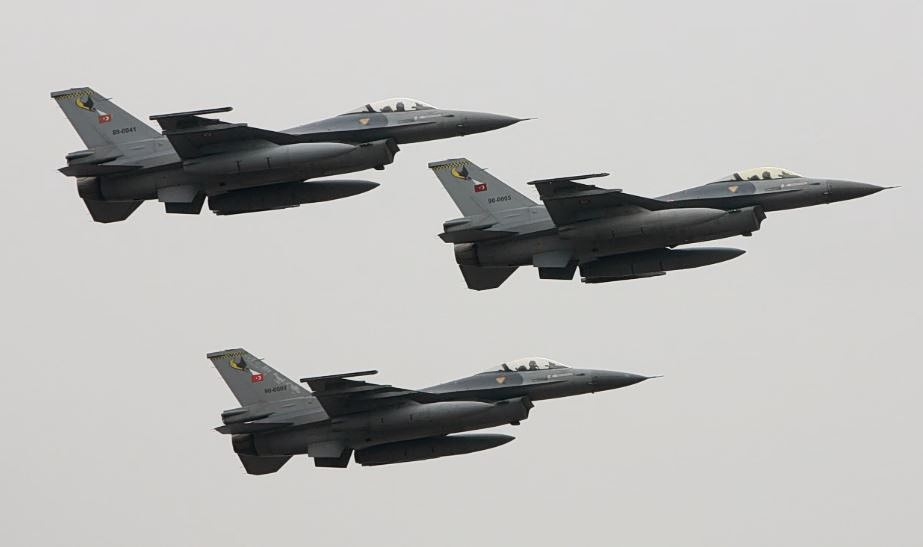





A group of bipartisan lawmakers is pressing Congress to lift long-standing restrictions on U.S. arms sales to Cyprus, citing a reported Turkish deployment of F-16 fighter jets to occupied Northern Cyprus.
Representative Nicole Malliotakis, Republican of New York, and other members of the Congressional Hellenic Caucus said the move underscores the need to strengthen Cyprus’s defenses and accelerate pending legislation that would permanently end the U.S. arms embargo on the country.
The push reflects growing concern on Capitol Hill over security dynamics in the Eastern Mediterranean, where tensions involving Turkey, Greece and Cyprus have increasingly intersected with broader U.S. interests, including NATO cohesion, Middle East instability and energy security.
“Turkey’s decision to deploy F-16s to occupied Cyprus … is a brazen provocation,” Ms. Malliotakis said in a statement, urging House leadership to bring the End Cyprus Embargo Act to a vote. The bill recently advanced out of the House Foreign Affairs Committee.
The United States imposed an arms embargo on Cyprus in 1987, aiming to discourage an escalation of the island’s division between Greek Cypriots and Turkish Cypriots. In recent years, Washington has partially eased those restrictions, allowing limited defense cooperation through annual waivers tied to financial transparency requirements and limits on Russian military access.
Supporters of lifting the embargo permanently argue that the current system has become impractical. Because waivers must be renewed each year, Cypriot officials face constraints in planning long-term defense purchases, particularly for advanced air defense systems designed to counter drones and other emerging threats.
Lawmakers also point to Cyprus’s expanding role as a logistical and humanitarian hub. The island has been used in past evacuations of civilians from the Middle East and is expected to serve a similar function in future crises, including for American citizens.
Congress Moves to Extend U.S.-Greece Military Training Program
At the same time, members of the Congressional Hellenic Caucus are advancing separate legislation aimed at deepening defense ties with Greece, underscoring what lawmakers describe as a critical partnership in a volatile region.
The U.S.-Greece Defense Cooperation Advancement Act, introduced by Representatives Chris Pappas, Gus Bilirakis, Dina Titus and Nicole Malliotakis, would reauthorize for five years the International Military Education and Training program, which brings Greek military officers to the United States for joint training and professional development.
Lawmakers say the program plays a central role in strengthening interoperability between the two countries’ armed forces and in building long-term ties between military leadership.
“Greece is a steadfast democratic ally of the United States, a pillar of stability in the Eastern Mediterranean, and an essential partner in ensuring regional security and prosperity,” Mr. Pappas said, calling the measure a necessary step to reinforce cooperation at a time of heightened global uncertainty.
Supporters of the bill point to Greece’s consistent defense spending within NATO and its expanding role on the alliance’s eastern and southern flanks. In recent years, Athens has increased investments in its military capabilities, including upgrades to its F-16 fleet and the acquisition of advanced air defense systems, moves that U.S. lawmakers say enhance collective deterrence.
The legislation builds on a series of measures passed by Congress in recent years, including the Eastern Mediterranean Security and Energy Partnership Act and subsequent provisions in the National Defense Authorization Act, which formally recognized Greece as a key security partner and encouraged closer military and energy cooperation.
For lawmakers backing the bill, extending the training program is both a practical and symbolic step, aimed at reinforcing a partnership that has taken on greater importance amid the war in Ukraine, instability in the Middle East and shifting security dynamics across the Eastern Mediterranean.
The focus on Greece reflects a broader shift in U.S. defense planning. American military access and infrastructure in the country have expanded in recent years, including at Souda Bay and the northern port of Alexandroupoli, now a key transit point for U.S. and NATO operations tied to Eastern Europe.
That shift has gained urgency since Russia’s invasion of Ukraine and the war between Israel and Hamas, both of which have underscored the Eastern Mediterranean’s role as a corridor for energy and military logistics.
Any move to permanently lift the Cyprus arms embargo would mark a break with decades of U.S. policy and could complicate relations within NATO, where Turkey remains a difficult but indispensable ally, according to U.S. officials.
For now, lawmakers are trying to turn the latest developments into legislative action, though the bills face an uncertain path in a Congress still balancing national security priorities with alliance politics.
Source: tovima.com