
![120 δόσεις: Από τον Νοέμβριο η ρύθμιση για χρέη στο δημόσιο [παράδειγμα]](https://www.ot.gr/wp-content/uploads/2023/06/ritmisi.jpg)

PPC is moving ahead with plans for a large data center in Kozani, in Western Macedonia as it looks to repurpose former lignite assets and build a new business around the rising power demands of digital infrastructure.
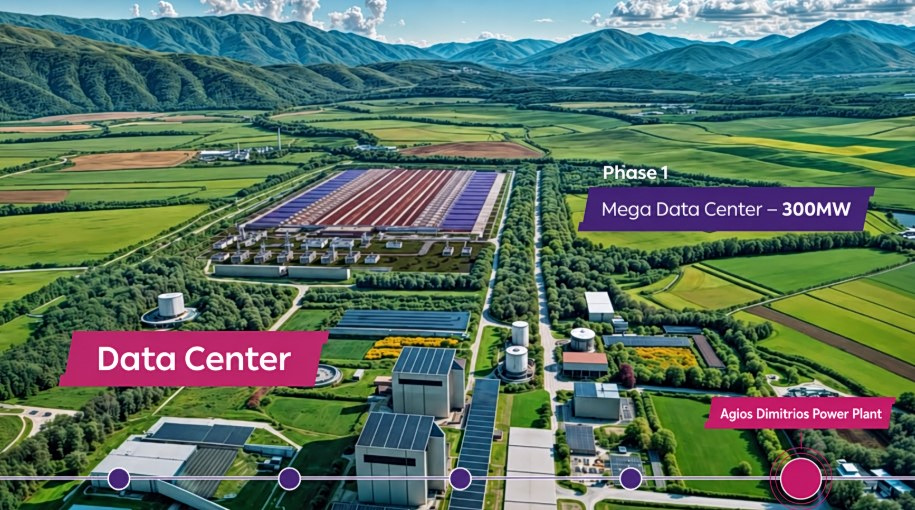
Under a binding memorandum of cooperation with Amazon Web Services (AWS), Amazon’s cloud-computing business, PPC plans to develop a 300-megawatt data center at the former Agios Dimitrios lignite power station. AWS would lease the facility for 15 years and operate its IT infrastructure. The two companies are also considering an expansion to as much as 1 gigawatt, subject to further definitive agreements.
The project is the first major international partnership to emerge from a strategy PPC has been developing since 2025, when it began setting out plans to use its land, power generation and network assets to attract large data center operators. Data centers account for about 5% of PPC’s roughly €24 billion investment plan for 2026-2030.
Rather than operate the computing infrastructure itself, PPC plans to own the buildings and related infrastructure and generate revenue from long-term leases. It would also supply electricity through power purchase agreements lasting more than 10 years and provide fiber-optic connectivity. This model, in theory, could allow PPC to combine land, power and telecommunications infrastructure, while hyperscale cloud operators install and run their own computing systems.
PPC and AWS are separately examining a multiyear partnership in cloud computing and artificial intelligence as part of PPC’s digital transformation.
A 300 MW first phase
The Agios Dimitrios project would start with four 75 MW units, giving PPC scope to add capacity as demand develops. The company expects the first 300 MW to be operational by the end of 2028 and has outlined a path to 1 GW within roughly three years of a final investment decision, with additions of about 300 MW a year.
PPC has put the cost of the initial 300 MW phase at about €1.2 billion. For the first two phases, taking total capacity to as much as 1 GW, it is targeting annual EBITDA of about €170 million by 2030, excluding any earnings from electricity sold under long-term power purchase agreements.
Planning work is already in advanced stages. Initial engineering studies have been completed, detailed design is underway and PPC has secured preliminary permit approval. The company has also applied for a grid connection, started tendering for electrical and mechanical equipment, while the necessary Environmental Impact Assessment (EIA) is underway. PPC has said construction could begin by the end of 2026.
Repurposing a former lignite site
The Agios Dimitrios site gives PPC access to both substantial land holdings and existing power infrastructure, two factors that underpin the company’s plans for a large-scale data center campus in West Macedonia. About 300,000 square meters are available at the site, providing space for the development to expand beyond its initial phase.
PPC plans to supply much of the facility’s electricity locally through a behind-the-meter model, reducing its dependence on power drawn from the wider grid. TPPC plans to combine solar power, battery storage and pumped hydro with a high-efficiency natural gas plant, giving the site a more reliable supply of electricity while retaining a connection to the national grid. PPC is targeting a power usage effectiveness, or PUE, ratio of 1.2. That would mean total energy consumption at the site would be about 20% higher than the electricity used directly by the computing equipment.
The facility is also being designed to meet Tier III standards, which would allow maintenance on critical systems without shutting down the data center.
Wider plans in Greece and abroad
Agios Dimitrios forms part of a much broader data center strategy. PPC has said it could provide up to 2 GW of data center capacity in Greece, with Kozani, Athens and Crete among the locations being considered for future projects.
The company is also examining expanding outside Greece. Its list of potential markets includes countries where it already operates, such as Romania and Italy, as well as Israel, Jordan, Libya, Egypt and Saudi Arabia. Across those markets, PPC has identified scope for a further 2 GW of capacity.
PPC’s strategy is based on combining assets the group already owns or controls, including land, access to electricity, renewable generation, storage, power networks and telecommunications infrastructure. Whether PPC can develop the business at that scale will depend on customer commitments and further investment decisions. Agios Dimitrios will be the first significant test of whether those assets can be converted into a durable business serving large cloud and data center operators.
Power as a constraint
PPC’s push into data centers comes as the spread of artificial intelligence and other computing-intensive services drives demand for processing capacity and, in turn, electricity. Global data center capacity, according to figures cited in PPC’s planning, rose from about 46 GW in 2020 to an estimated 78 GW in 2025 and is expected to reach 163 GW by 2030.
That growth has made access to electricity and grid connections an increasingly important factor in the development of new data centers. PPC’s strategy rests on using its existing energy infrastructure to offer large volumes of power in locations where suitable land and network access are already available.
Source: tovima.com










![Ακίνητα: Κύμα μεταβιβάσεων ενόψει του φόρου 15% [πίνακας]](https://www.ot.gr/wp-content/uploads/2026/07/akinita.png)