



Uncertainty continues for Greek exporters to the United States following the US Supreme Court’s decision to strike down key tariffs imposed by President Donald Trump under the International Emergency Economic Powers Act (IEEPA).
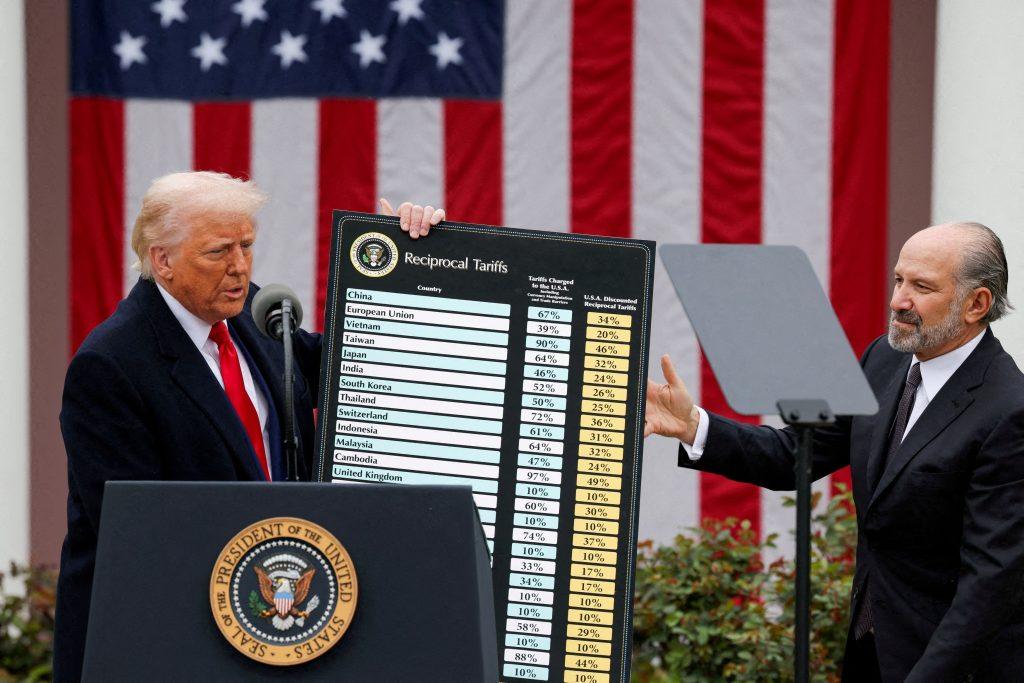
In a 6–3 ruling, the justices found that the president had exceeded the authority granted by Congress under the 1977 law, which allows the executive to regulate commerce during national emergencies stemming from foreign threats. The decision concerned tariffs imposed on imports from Canada, China and Mexico through the so-called “fentanyl” executive orders, as well as broader “reciprocal” tariffs applied to imports from all countries.
Within hours, the US President introduced a new temporary mechanism. As of 12:01 a.m. EST on Feb. 24, 2026, a global additional 10% ad valorem tariff has been imposed on all imports into the United States under Section 122 of the Trade Act of 1974.
‘More of the Same, With a Twist’
“It’s more of the same … with a twist,” said Alkiviadis Kalabokis, president of the Panhellenic Exporters Association, commenting on the new data shaping Greek exports to the US.
He noted that confusion is widespread. While there is political intent to raise the tariff rate to 15%, that intention has not yet been validated through a legal act. The officially published framework currently provides for a 10% rate. Any change would require a new official decision and corresponding customs enforcement procedures.
Refunds and Legal Gray Areas
A further critical issue concerns refunds for duties paid under the tariffs that were deemed unlawful. The Supreme Court decision did not clarify the mechanism for compensating importers.
US Customs and Border Protection has stated that it is examining the implications of the ruling. At the same time, legal circles appear divided. Some suggest that importers should file formal objections to safeguard their right to refunds, while others argue this may not be necessary. As a result, uncertainty continues.
According to CNBC, despite the Supreme Court’s ruling that Trump’s “reciprocal” tariffs were unlawful, American importers are still paying duties on goods entering the country. US Customs and Border Protection has not yet updated the Cargo Systems Messaging Service to reflect the removal of the IEEPA-based tariffs.
Under US trade policy, Customs is required to publish updates regarding tariff changes and other trade-related information through that system. Until such updates are formally issued, the practical implementation remains in question.
EU Freezes Trade Agreement Ratification
The uncertainty has also affected transatlantic relations.
According to Bloomberg, the European Union is moving toward freezing the ratification process of its trade agreement with the United States and is seeking further details from the Trump administration regarding the new tariff program.
At the same time, members of the European Parliament from different political groups told Agence France-Presse that they support suspending the ratification process until there is greater clarity about what the court ruling means for the European Union.
The New Regime and the ‘America First’ Doctrine
Following the Supreme Court’s Feb. 20, 2026 decision, the new temporary regime now in effect adds a 10% global ad valorem tariff on top of the base customs duty under the Harmonized Tariff Schedule. The measure applies to all countries and is set to remain in force for up to 150 days, through July 24, 2026, unless extended with congressional approval.
The earlier horizontal tariffs imposed under IEEPA no longer apply. Yet with political signals pointing toward a possible return to a 15% rate, exporters and importers alike are navigating a rapidly evolving trade landscape.
The Supreme Court decision initially created the impression of a setback for the White House. However, the swift activation of a new tariff mechanism underscores that trade protectionism remains central to Trump’s economic approach.
Under the “America First” doctrine, tariffs have consistently served as a primary policy tool. The latest developments suggest that while the legal basis may shift, the broader direction of US trade policy remains firmly protectionist.
Source: tovima.com


















![Airbnb: «Φουλ» οι κρατήσεις για το Πάσχα – Οι hot προορισμοί [πίνακας]](https://www.ot.gr/wp-content/uploads/2025/12/ot_airbnb33-1024x600-1.jpg)