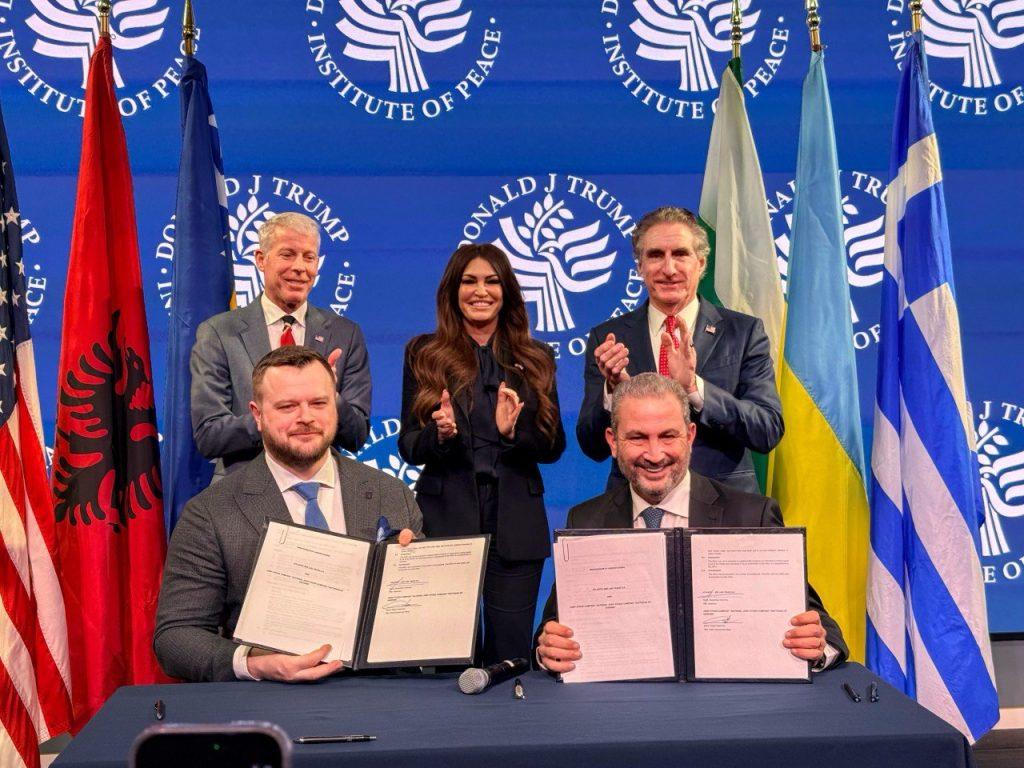


Four long-term agreements signed by Atlantic SEE LNG Trade with four companies from Southeast Europe are being portrayed as a milestone in the region’s fast-evolving energy landscape.
The deals, concluded during a ministerial summit in Washington organized by the White House and the U.S. National Energy Dominance Council, underscore the growing role of US liquefied natural gas (LNG) in Europe’s energy strategy. What was once considered a supplementary option is now emerging as a central pillar of the continent’s post-Russian supply architecture.
Four Countries, One Corridor
Atlantic SEE LNG Trade — a joint venture between Greece’s AKTOR Group (60%) and DEPA Commercial (40%) — signed agreements with:
Albania’s Ministry of Infrastructure and Energy
Bulgaria’s state-owned BULGARGAZ
Aluminij Industries and M.T. Abraham Group of Bosnia and Herzegovina
Ukraine’s Naftogaz
The agreements secure stable LNG volumes over a multi-year horizon and position Atlantic SEE as a commercial conduit for U.S. LNG into the so-called Vertical Gas Corridor.
The corridor links Greek energy infrastructure with Bulgaria, Romania, Moldova and Ukraine, while also serving the wider Western Balkans. The strategy aims to channel LNG imported through Greece northward into Central and Southeastern Europe.
The company was represented in Washington by its CEO, Alexandros Exarchou, who also heads the AKTOR Group.
Earlier in January, Atlantic SEE marked its first regional transaction with a U.S. LNG sale to Ukraine, with BP as supplier and Naftogaz as buyer, signaling the start of its commercial footprint in the regional gas market.
A Political Umbrella for Energy Diversification
The agreements were signed against a broader political backdrop.
Representatives from 13 European governments — including Greece, Poland, Lithuania and Ukraine — joined U.S. officials in endorsing a joint declaration focused on diversifying supply sources and increasing transparency in gas markets. While the declaration does not impose binding quantitative targets, it lays the groundwork for a more liquid market environment with fewer regulatory barriers.
It also calls for mobilizing public and private capital for new or upgraded LNG infrastructure in countries such as Croatia, Greece, Lithuania and Poland.
A key element of the framework is the integration of Ukraine’s gas storage facilities into the broader regional market — a move that could strengthen supply resilience across Eastern Europe.
Greece’s Bid to Become an Energy Hub
For Greece, the summit offered a platform to reinforce its ambition to serve as a regional energy hub.
Environment and Energy Minister Stavros Papastavrou described the Vertical Corridor as a strategic choice that transforms Greece’s geography into geopolitical leverage. Investments in floating storage and regasification units (FSRUs), interconnectors and LNG commercial agreements are designed to ensure the country is not merely a transit route, but a decisive node influencing energy flows into Southeast Europe.
However, Greece is not alone in pursuing gateway status.
Poland is expanding its gas infrastructure, including plans for a new FSRU in Gdansk on the Baltic coast, strengthening links to Central Europe. Lithuania has also promoted the Baltic route as an alternative supply pathway.
Meanwhile, Germany has agreed via the Deutsche ReGas terminal to channel cargoes supplied by TotalEnergies to Ukraine through Poland, under an arrangement with Naftogaz.
As supply corridors multiply, competitiveness in pricing, transit tariffs and infrastructure delivery timelines is becoming increasingly critical.
Notably, in January, European LNG imports from the United States accounted for nearly 60% of total U.S. LNG exports — a figure that highlights the scale of the transatlantic shift.
Beyond LNG: Shipbuilding and Digital Ambitions
Discussions in Washington extended beyond gas contracts.
An anticipated agreement between ONEX Shipyards and Technologies — operator of the Elefsina shipyards in Greece — and South Korea’s Hanwha Power Systems points to shipbuilding’s integration into the broader energy strategy. LNG carriers and FSRUs are essential for any country aspiring to a long-term role as an energy hub.
There are also expectations of further agreements in the coming days, including potential U.S. financing for a second FSRU in Thrace by Gastrade.
At the same time, Public Power Corp. (PPC) CEO Giorgos Stassis is holding talks with hyperscale technology companies regarding a planned 300-megawatt Mega Data Center project, with expansion potential to 1 gigawatt. Progress on that investment would depend on the signing of a binding agreement.
A Broader Transatlantic Framework
The summit, co-chaired by U.S. Interior Secretary and Energy Dominance Council head Doug Burgum and U.S. Energy Secretary Chris Wright, brought together representatives from 22 governments, senior EU officials and about 50 companies, including Chevron, ExxonMobil, Cheniere Energy, Berkshire Hathaway, Glencore, ConocoPhillips, S&P Global, Shell USA, Siemens Energy and Woodside Energy Group.
Transmission system operators such as Bulgartransgaz, TotalEnergies, Orlen and Transgaz were also present.
Source: tovima.com











![Airbnb: «Φουλ» οι κρατήσεις για το Πάσχα – Οι hot προορισμοί [πίνακας]](https://www.ot.gr/wp-content/uploads/2025/12/ot_airbnb33-1024x600-1.jpg)