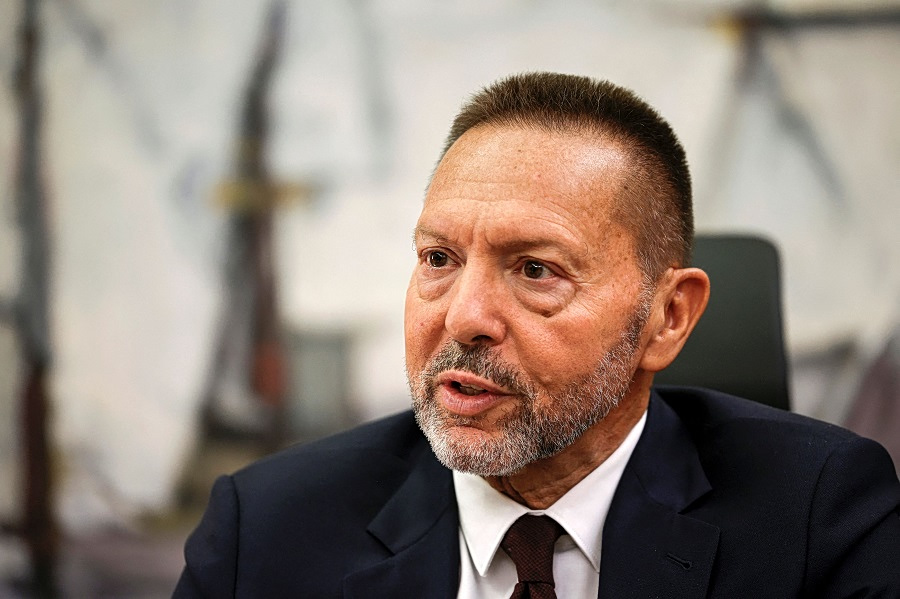




Bank of Greece (BoG) Governor Yannis Stournaras called for artificial intelligence (AI) development to be accompanied by robust institutions, investment in skills, and effective supervision, speaking at the 4th “Quo Vadis AI?” conference on artificial intelligence, labor markets, and central banks.
Stournaras described AI as a historic technological shift already transforming economies, labor markets, and the operations of central banks. “Artificial intelligence is not a theoretical possibility or a technological promise for the future,” he said. “It is already present and is changing the framework within which economic and monetary policy are conducted.”
The governor said the global economy was facing a transition of unprecedented scale, simultaneously affecting productivity, employment, geopolitical power, and income distribution. Citing European Central Bank President Christine Lagarde, he warned that the world was moving “from a world where risk could be measured and modeled to a world of genuine uncertainty.”
On growth and inflation, Stournaras acknowledged that AI had the potential to serve as a powerful driver of productivity gains with positive implications for economic growth and real incomes, but cautioned that the transition would not be smooth.
Stournaras highlighted the profound changes artificial intelligence was bringing to the world of work, noting that its impact was no longer confined to the automation of manual or repetitive tasks but was now extending into knowledge work, analysis, and decision-making.
“This new reality raises a critical question: will artificial intelligence function as a force that amplifies human creativity, or as a mechanism for widening inequality and concentrating power?” he said, providing his own answer: “The response is not technological. It is institutional.”
Source: tovima.com