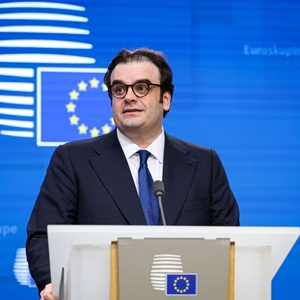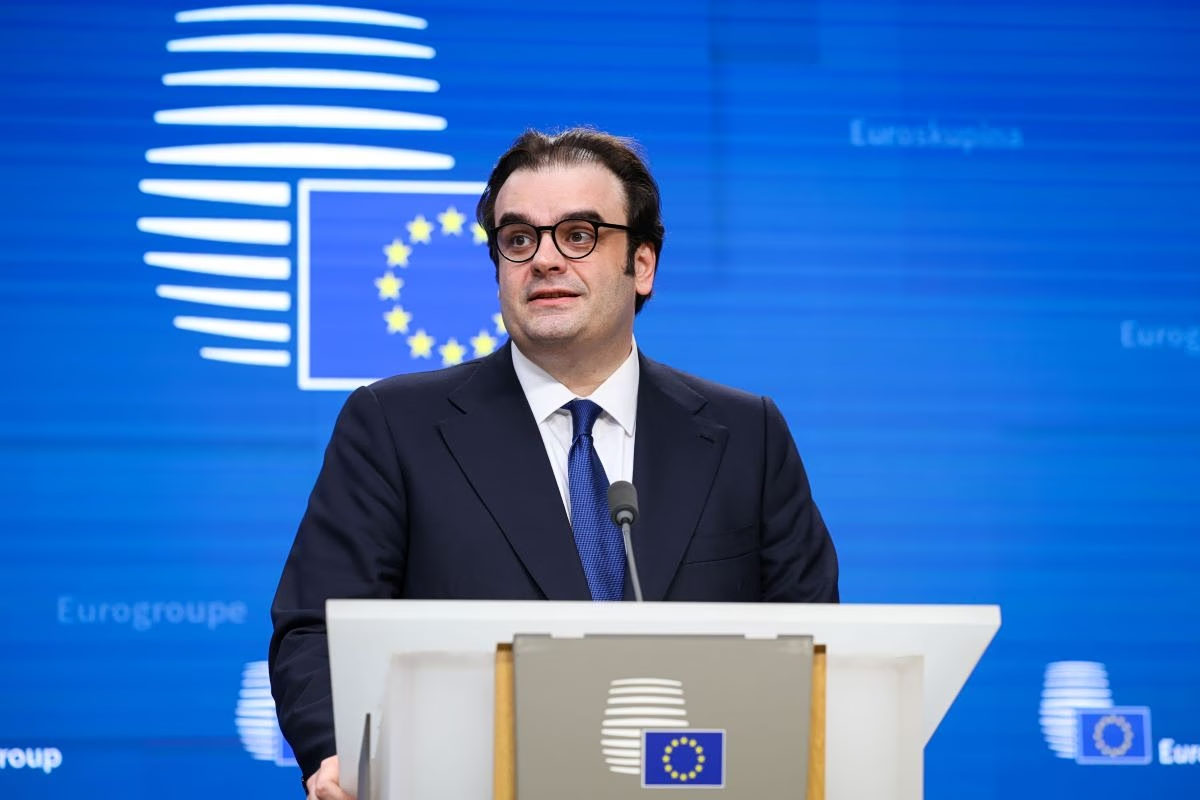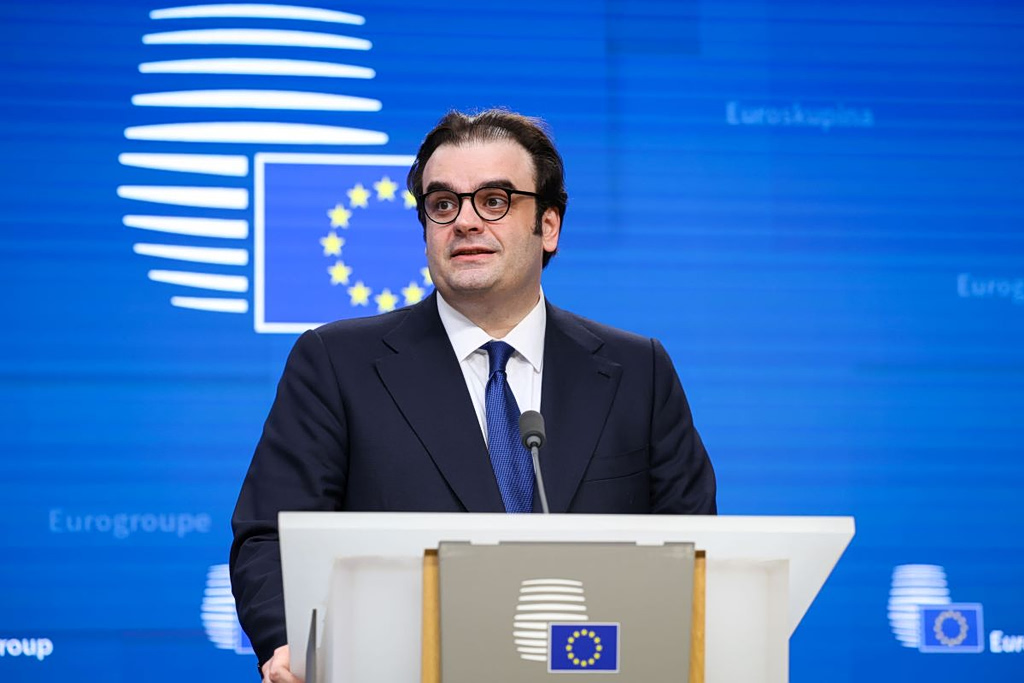


The era of cheap and abundant capital is over, but Europe has a strong fiscal framework and is not facing a debt crisis, Greek Finance Minister and Eurogroup President Kyriakos Pierrakakis said in an interview with CNN.
Speaking to journalist Richard Quest on the sidelines of the annual meetings of the International Monetary Fund (IMF) and the World Bank in Bangkok, Pierrakakis said rising bond yields reflect broader international pressures rather than problems confined to individual European countries.
He stressed that markets closely monitor each country’s fiscal position and that a government’s credibility is reflected in its borrowing costs.
“The era of cheap and abundant capital has passed globally,” Pierrakakis said, adding that higher bond yields were creating additional pressure on public finances already facing significant challenges.
However, he argued that Europe’s current position differs substantially from the conditions that prevailed during the sovereign debt crisis of a decade ago.
“We are monitoring the situation carefully, but we are not overly concerned,” he said.
Higher borrowing costs put pressure on public finances
Pierrakakis pointed to the sharp increase in European bond yields over the past decade. The average bond yield in Europe stood at 1.1% ten years ago, compared with an average yield of 4.4% for 10-year bonds today, he said.
He attributed the change to a combination of global factors, including rising inflation expectations, energy costs and artificial intelligence.
Europe’s fiscal position has also come under pressure. According to Pierrakakis, the region’s average fiscal deficit has more than doubled from 1.7% a decade ago.
Nevertheless, he argued that European countries have strengthened their public finances and developed fiscal institutions capable of managing the current challenges.
Asked whether he expected a debt crisis in major European economies, Pierrakakis said the situation was fundamentally different from that of 10 or 12 years ago.
His comments came amid questions about rising borrowing costs in France and Italy compared with Germany. He agreed with European Central Bank President Christine Lagarde’s assessment that France must address its own debt problems, also citing remarks by François Villeroy de Galhau, governor of the Bank of France.
Governments can support households without abandoning fiscal discipline
Pierrakakis acknowledged the challenge facing European governments as they seek to respond to rising energy costs while maintaining fiscal stability.
He rejected the suggestion that calls for greater fiscal flexibility were inherently incompatible with the IMF’s recommendation that governments limit fiscal expansion.
Instead, he argued that countries could adjust the composition of spending within the existing European fiscal framework and make use of its flexibility mechanisms without increasing overall spending.
He also referred to the European Union’s escape clause for defense spending, under which energy investments have been included, and said discussions were underway on how to use the mechanism more effectively and selectively.
Speaking separately in his capacity as Greece’s finance minister, Pierrakakis said the government had introduced a package of measures worth €1.4 billion this year to support households and businesses.
He said Greece was able to provide that support because it had put its public finances in order.
At the European level, he argued, governments could help citizens through a difficult period while preserving fiscal stability.
Europe was in a stronger position than when Russia invaded Ukraine, he said, pointing to increased energy investment and greater diversification of energy sources.
Further investment is needed in energy storage, electricity grids and cross-border interconnections, he added.
Pierrakakis calls for faster financial integration
The interview also focused on the pace of European financial reform, particularly the long-running effort to complete the EU’s Banking Union.
Quest questioned whether meaningful progress was likely, noting that similar commitments had been made repeatedly by previous Eurogroup presidents and the head of the European Central Bank.
Pierrakakis disagreed, emphasizing the need to move beyond declarations and implement reforms.
“Our motto must be: implementation, implementation, implementation,” he said.
He pointed to progress on the European capital markets agenda, arguing that more had been achieved in the previous 10 months than in the preceding decade. He also cited an initial agreement in the Council on capital markets supervision as a step toward directing more investment into the European economy.
The same progress, he said, should be possible in the banking sector.
Pierrakakis argued that European banks need to grow in scale and invest more across the continent, provided that barriers to expansion are removed. He also cited the need to mobilize resources and build larger companies capable of competing internationally.
He referred to the findings of reports by former European Central Bank President Mario Draghi and former Italian Prime Minister Enrico Letta, which have outlined challenges facing European competitiveness and the need for greater scale.
Europe needs larger companies to close productivity gap
Pierrakakis argued that fragmentation within the European market continues to constrain businesses and investment.
Citing an IMF estimate, he said barriers in Europe’s services sector were equivalent to a tariff of 110%, while barriers in manufacturing were equivalent to 44%.
He also said that one-third of the productivity gap between Europe and the United States could be attributed to the lack of sufficiently large companies in Europe.
The continent needs stronger banks and larger businesses capable of operating across national borders, he said, describing them as potential “European champions.”
Quest challenged the idea that all countries could benefit equally from the creation of large pan-European companies, arguing that governments would have to accept that some countries and sectors might gain more than others.
Pierrakakis maintained that building companies with a European scale could benefit all countries by enabling growth at a greater level.
He acknowledged that national interests have historically slowed integration, with governments often supporting European initiatives in principle but raising concerns about domestic exceptions when it comes to implementation.
However, he argued that the changing international environment was forcing European governments to reconsider that approach.
“The era of geopolitical innocence is coming to an end,” he said, pointing to growing geopolitical fragmentation and the need to diversify energy sources.
European governments, regardless of their political orientation, are increasingly aware of these challenges, Pierrakakis said. He described his outlook not as optimism but as realism, arguing that Europe would make substantial progress in the period ahead.
Source: tovima.com