
Across Europe and beyond, a generation is on the move. In France, high school students who began protesting over crumbling classrooms have sparked one of the largest social movements the country has seen in years. In Italy, students occupied schools in solidarity with their French peers. In Albania, young people have been in the streets for nearly five months demanding an end to corruption. And in Serbia, a student movement born from protest is today challenging the ruling party at the ballot box.
The causes differ from country to country, but the message is strikingly similar: young people believe the promise of a better life than their parents’ is slipping away, and they want change.
France: From Classrooms to the Streets
The French movement started in mid-September, when students aged 15 to 18 began protesting against teacher shortages, leaking and crumbling school buildings, and classrooms so overcrowded that there were not enough chairs. Teachers, parents and trade unions soon joined in, turning it into the country’s biggest youth movement in years.
Alice de Brito, vice president of France’s main student union, UNEF, told CNN that student protests have taken place at the start of every school year for the past nine years, as young people return to find too few teachers and poor equipment. This year was different. Students demanded smaller classes, more spending on teachers, school buildings ready to withstand the climate crisis and an end to police violence against young people. “People are just tired of waiting for an answer,” she said.
Early in October, a student rally drew more than 250,000 people and over 500 schools closed, prompting Prime Minister Sébastien Lecornu to promise a package of reform proposals. By mid-October, the movement had broadened into nationwide marches against the rising cost of living, which has been driven up in part by the US-Iran war.
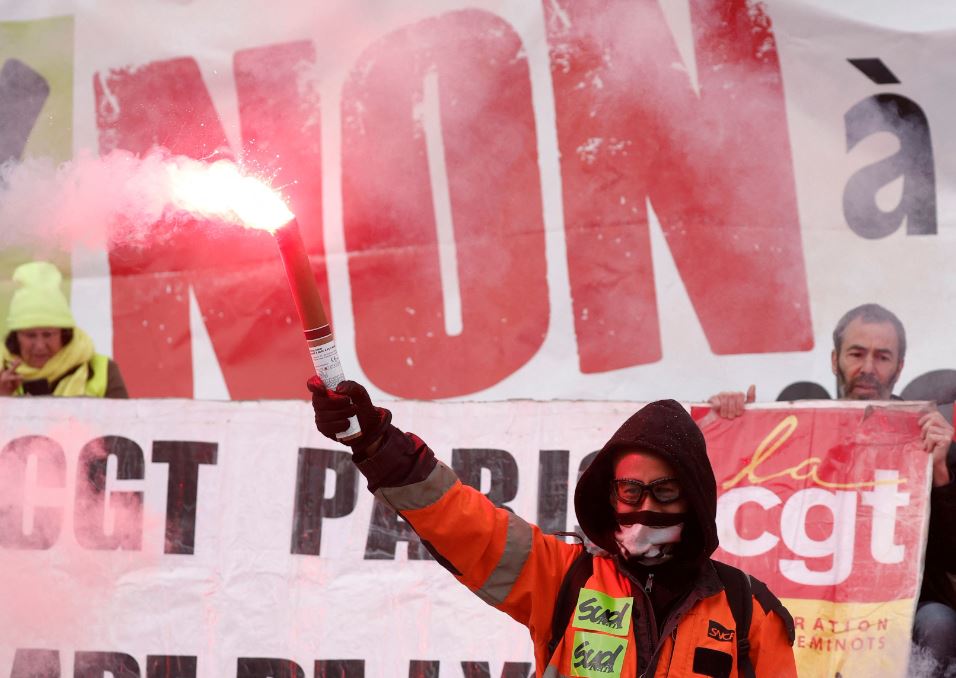
On Saturday, hundreds of thousands marched again in cities including Paris, Marseille, Lyon, Lille, Bordeaux and Orléans. The government counted about 400,000 protesters nationwide, while unions put the figure at roughly 800,000. In Paris, where at least 110,000 people took part, the march was organized by UNEF and joined by the CGT union, farmers, climate activists and members of the Yellow Vest movement.
The mood in the capital was peaceful and upbeat. Brass bands played, and families marched with children and grandchildren. Many carried banners defending the right to protest.
“I’m out again peacefully today to support everyone who is brave enough to demonstrate,” said Nadège, a 43-year-old communications worker who had been tear-gassed at a march the week before. “It does take courage. People are afraid now.
Pierre, a 60-year-old retired banking consultant, said he was marching for his eight-year-old granddaughter. “I want her to have a brighter future than the sombre times we are facing today,” he said. Jesse, a 40-year-old charity worker carrying a “Free Hugs” sign, said she was proud of the students. “We have to stand together,” she said.
Two teenagers told the BBC their generation felt abandoned by the government and that the protests would continue until their demands were met. “We really want a change in France,” one said.
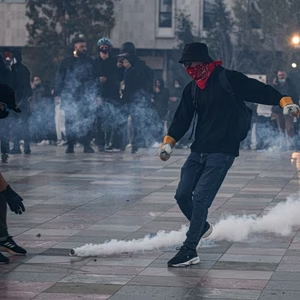
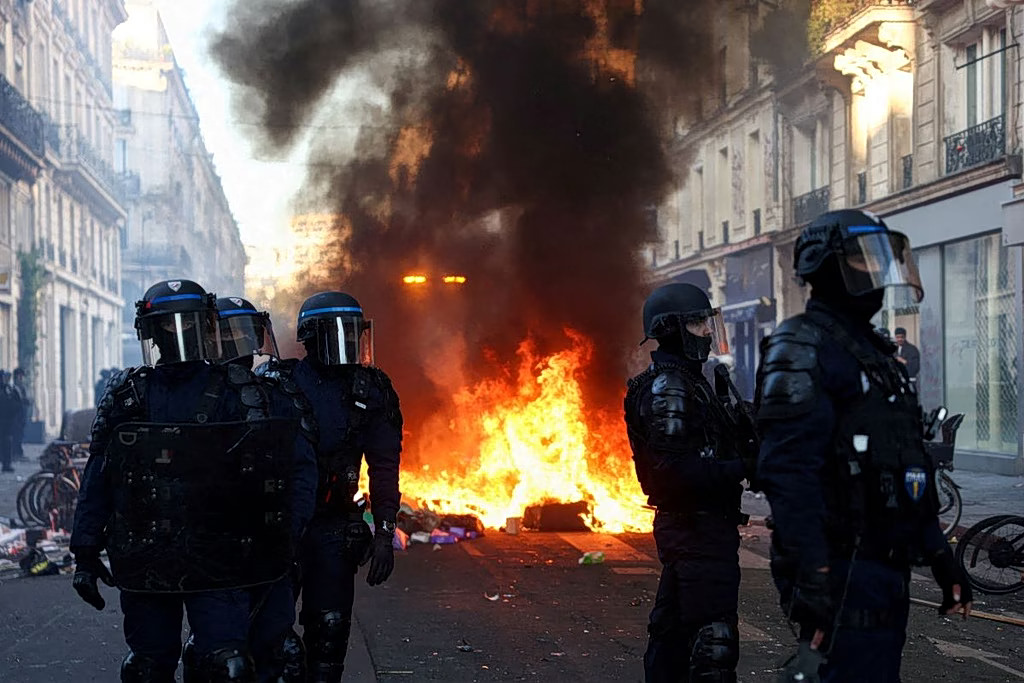
As on the previous weekend, small groups of masked people broke away from the marches at the end of the day and clashed with police in Paris and a few other cities. Authorities reported nearly 1,000 arrests. The overwhelming majority of marchers, however, demonstrated peacefully.
Policing Becomes Part of the Grievance
For many young protesters, the way the state has responded has become a cause in itself. Several teenagers have suffered life-changing injuries during the student protests: one had a hand blown off by a police stun grenade, another was blinded in one eye and another had his jaw broken. By mid-October, police had detained 6,773 minors since the student protests began, and the injury to a 15-year-old became a key rallying point.
Amnesty International has called the police response disproportionate, and the French League of Human Rights has condemned what it calls the violent repression of the high school movement. Sebastian Roche, a researcher at France’s National Centre for Scientific Research, told DW that by measures such as deaths and maiming during crowd control, French police are the most brutal in the EU. The national police’s internal inspectorate says it has opened at least 40 cases since the latest protests began. Interior Minister Laurent Nuñez maintains that officers have largely acted proportionately.
Anger also grew this week after President Emmanuel Macron ruled that only union-organized demonstrations would be permitted, and marches were kept away from city centers. “We feel in France that we are increasingly living in an authoritarian regime that is trying to stop our democratic right to protest in the street,” said a 21-year-old student from a blockaded Paris science faculty.
Jérôme Rodrigues, a well-known Yellow Vest figure, said the government was afraid and that police shields were no answer for people who cannot make ends meet. Radical left presidential candidate Jean-Luc Mélenchon said Macron must give in and address the country’s social discontent or face protests every week. With the presidential election six months away, the movement has become a test for every candidate.
Italy: “Like in France”
The French movement has inspired students elsewhere. When students first occupied a high school in Rome on October 7, they opened their statement with the words “like in France.” At a rally last weekend, student union leader Sabrina Brizzola called for “schools that don’t collapse on our heads, for safe and dignified work, for public healthcare, for social justice.”
Students at a protest camp in Rome told CNN that affordable housing and good education go hand in hand. Elisa Pastore said she and her brother can barely afford to share a room in the capital, and that she once commuted 120 kilometers (75 miles) to university to save money.
In Milan, authorities deployed hundreds of soldiers alongside police on Saturday and prevented protesters from gathering, after clashes on the sidelines of demonstrations the week before. Education Minister Giuseppe Valditara has insisted that Italy’s situation is very different from France’s, but frustration over costs is spreading beyond students: a truckers’ blockade over fuel prices has halted production of buffalo mozzarella and some pasta.
Albania: Five Months of Protest
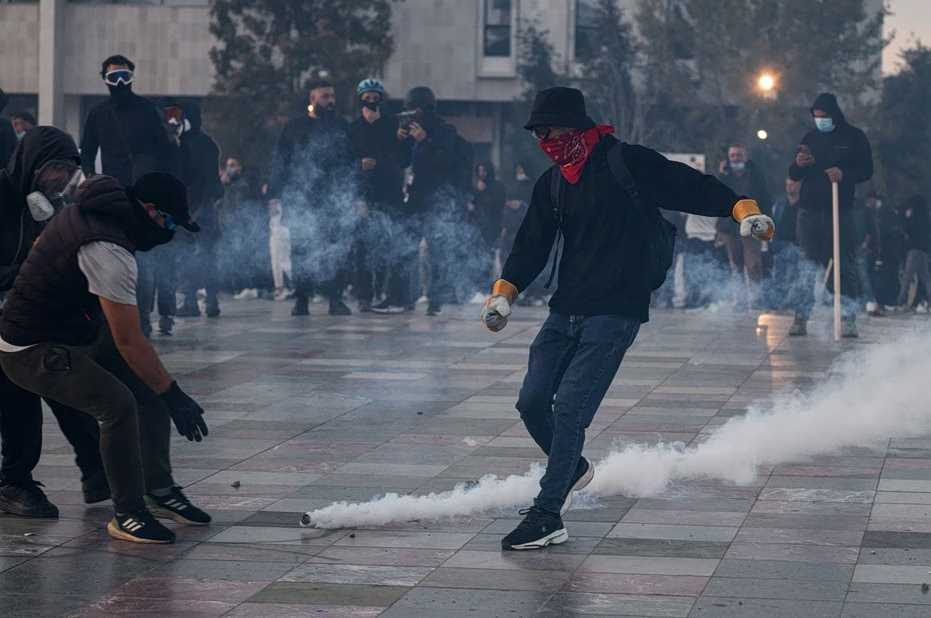
In Albania, the protests began nearly five months ago, after plans emerged for a luxury hotel complex in a nature reserve backed by Jared Kushner, the son-in-law of US President Donald Trump. They have since grown into a broad movement against corruption, mismanaged universities and the rising cost of education, with students calling for the resignation of Prime Minister Edi Rama, in office since 2013. On Saturday, riot police used tear gas to disperse thousands of protesters outside the prime minister’s office in Tirana.
The movement has no leaders and no central command. Young Albanians organize through Instagram, WhatsApp groups for their classes and dormitories, Telegram channels and TikTok, cybersecurity advocate Besmir Semanaj told DW, which is why the government struggles to understand or control it.
Rama has described the uprising as a “hybrid war,” blamed Greece, Russia and Iran at various points, and most recently accused “antifa.” Experts told DW there is no evidence for such claims. Arlind Qori, leader of the opposition Together Movement, said young people are outraged by poverty, the emigration of their parents, a declining education system and a lack of prospects after graduation. “People aren’t demanding anything radical,” he said. “They merely want a corrupt head of government to resign.”
A protester who asked to be called Sara said she rejected the “terrorist” label. “As soon as I see violence, I walk away; I’m against it,” she said. “We want a change, that’s why we’re here,” another protester told Reuters.
Serbia: From the Streets to the Ballot Box
In Serbia, the student movement that emerged after the deadly collapse of a canopy at Novi Sad railway station in November 2024 is today contesting parliamentary elections as the Student List, the strongest challenge yet to Aleksandar Vucic’s rule. At their final rally in Belgrade, many supporters arrived after walking for days from across the country. Political scientist Dusan Spasojevic told DW that polls suggest the Student List could win more than 40% of the vote, making these the first truly competitive elections since Vucic came to power in 2012.
A Continent, and a World, in Motion
The wave reaches well beyond these countries. In Spain, the eviction of 87-year-old Maricarmen Abascal, who died two weeks later, triggered housing protests that forced the government to call snap elections. In Portugal, thousands have gathered every evening this week in Lisbon’s Rossio Square, demanding rent caps under the slogan “Homes to live in.”
In Greece, students and teachers outside parliament in Athens chanted for free public education “from Greece to France.” Students in Belgium have protested education cuts, and more than 100 people were arrested at a student protest in Barcelona on Saturday.
Since the start of October, Gen Z-led protests have taken place in more than ten countries, including Ecuador, Argentina and Chile in South America and India and Indonesia in Asia. In Chile, student unions protested proposed education cuts in the 2027 budget. In India, the Cockroach movement has emerged as the strongest challenge to Prime Minister Narendra Modi, with anger growing over the removal of more than 130 million names from voter rolls.
Student unions are also learning from each other. “I see so many more similarities than differences,” de Brito said. “We are all talking about the need for investments in education, in the universities, in youth in general. But we are also talking about the cost of living, about housing.”
Why Are They Angry?
In an opinion piece for Al Jazeera, Oscar Berglund, a senior lecturer in international public and social policy at the University of Bristol, argues that inequality, along both class and generational lines, lies at the heart of the protests. He points to rising income and wealth gaps since the 2008 financial crisis and years of austerity that have weakened public education, health care and social services. Young people, he writes, face underfunded schools, AI eating into entry-level jobs, rents that take a far bigger share of income than for previous generations, and a climate crisis that will make their lives more precarious than their parents’.
Julius Fintelmann, co-founder of the European Correspondent newsletter, told CNN the protests reflect a sense that Europe’s politics is failing the next generation. “This promise that liberal democracy had, which was that the next generation will enjoy a better life than the current one, that promise simply doesn’t hold true anymore,” he said.
The countries most affected, including France, Italy, Spain, Portugal, Greece and Belgium, share weak growth and high public debt, leaving governments little room to spend. Berglund notes that governments have mostly responded with repression, which in France and India has so far fueled the movements instead of ending them. He argues that only real efforts to address inequality can prevent deeper political crises.
What Comes Next
The movement shows no sign of slowing. Major unions have called general strikes in France on November 5 and in Spain on November 11. In Germany, a group called “Gen Z regelt” has called for peaceful protests in 21 cities on October 31. Student unions in Britain and Italy are planning a joint day of action on November 20 against the rising cost of education.
For now, as de Brito put it, young people are still waiting for an answer.