



A Greek civil court has rejected a lawsuit filed by Grigoris Dimitriadis against Alter Ego Media, in.gr managing editor Argyro Tsatsouli and myself, in a ruling that carries implications well beyond the case itself. The lawsuit concerned an article published by in.gr on October 23, 2023, titled “Wiretapping: The Investigation Is Being Upgraded — What Are the Government and Opposition Saying.”
This is the first of 22 SLAPP lawsuits Dimitriadis has filed against Alter Ego Media and its journalists to produce a ruling — and its reasoning matters. It is a ruling that plainly and simply defends the right of journalists and media outlets to report on Grigoris Dimitriadis in connection with the wiretapping scandal, to raise reasonable questions about his possible involvement in it — an affair that Prime Minister Kyriakos Mitsotakis himself has described as “a shadow over the government” — without facing lawsuits whose sole purpose is to silence them and prevent them from doing their job.
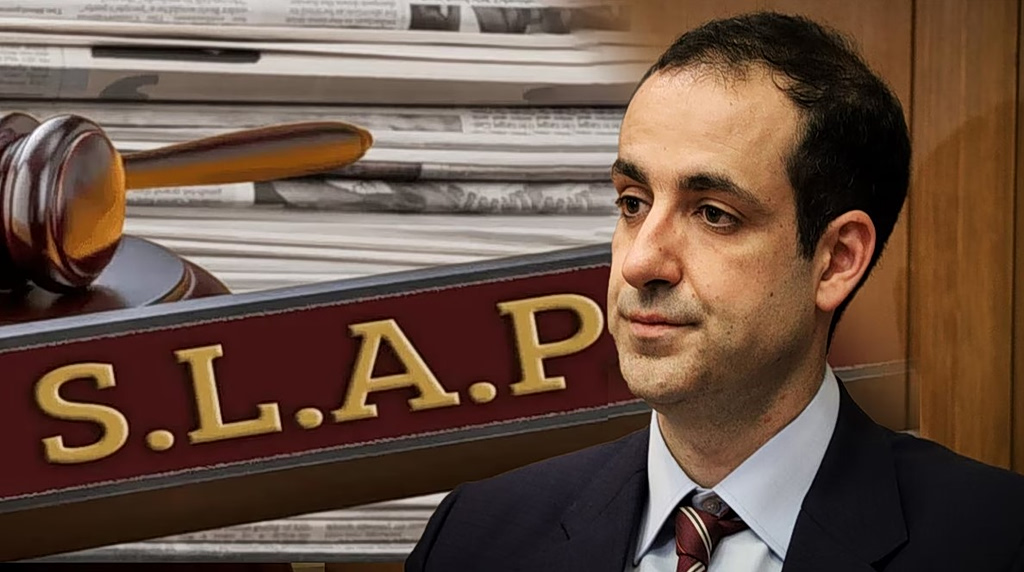
We use the term SLAPP deliberately and not loosely. SLAPP suits — Strategic Lawsuits Against Public Participation — are legal actions whose purpose is not to prevail in court but to silence journalists and media outlets through the sheer weight of legal costs and proceedings. The term is particularly apt at this moment, given that a Justice Ministry bill on protection against exactly such lawsuits is currently being debated in Parliament’s Standing Committee on Public Administration, Public Order and Justice. At the time of this ruling, Dimitriadis has sent 35 cease and desist notices and filed 22 lawsuits against Alter Ego Media. I am personally named as a defendant in 21 of those lawsuits and 29 of those cease and desist notices.
We had reached the point where almost every article that mentioned the wiretapping scandal and Grigoris Dimitriadis in the same text would get us a cease and desist notice — and very often a lawsuit on top of it. Cease and desist notices and lawsuits that were in reality designed to make it impossible to report on Dimitriadis in connection with the wiretapping scandal at all. That is, to suppress the fact that he served as secretary-general of the prime minister’s office during a period when the Greek National Intelligence Service (EYP) , had been placed under the direct supervision of the prime minister’s office; that he held formal signing authority over matters relating to EYP; that he was personally acquainted with figures involved in the case; and that reasonable questions about his role in the affair could and should be raised — questions he himself has since acknowledged, in a recent interview, that he knows the answers to but will never address publicly.
The court’s reasoning was unambiguous. On the question of public interest, it found that “the case of illegal wiretapping and the use of Predator software had already, at the time of publication, become the subject of wide public debate and institutional scrutiny, occupying not only the domestic and international press but also Parliament’s Committee on Institutions and Transparency.”
On Dimitriadis’s status as a public figure, the ruling noted that “his name had repeatedly come up in public debate, and information and assessments regarding his possible role in the affair had already been publicly aired. The prime minister’s public statement on the assumption of political responsibility for the scandal had preceded the article, as had a BBC report that made direct reference to the plaintiff, his resignation and his role in the scandal.” The connection between the wiretapping scandal — the court’s own word — and Grigoris Dimitriadis was already part of the public record before our article was published. The ruling also noted that as recently as August 2024, Parliament’s Committee on Institutions and Transparency had debated an opposition request to transmit the prosecutor’s findings to Parliament — and that even the government majority’s refusal to accept that request “demonstrates that the case continued to be the subject of institutional deliberation and intense public interest.”
The court addressed the constitutional role of the press directly. “In a democratic society,” it stated, “the press does not fulfill its constitutional role only when it reports already proven facts, but also when it conveys, with due journalistic diligence, information that is the subject of serious public debate and institutional scrutiny.” It also warned against the chilling effect of an overly punitive standard: “The subsequent assessment of the accuracy of journalistic information should not be based on facts that became known after publication, but on the facts that were reasonably available at the time of publication. A different approach would lead to excessive discouragement of investigative journalism, especially when it concerns matters of exceptional public interest.”
Its conclusion left no room for ambiguity: “The defendants acted within the framework of the constitutionally guaranteed freedom of the press and their social mission to inform the public on matters of current affairs, and had an obligation and a duty toward their readership to publish the article in question, which concerned a matter of significant public interest.”
That is precisely the point. What we did — and what we will continue to do — is journalism, however many legal notices and lawsuits follow. Democracy cannot exist without accountability. And accountability cannot exist without a free press that uncovers facts, brings information to light and asks the questions that the public has a right to have answered.
Source: tovima.com